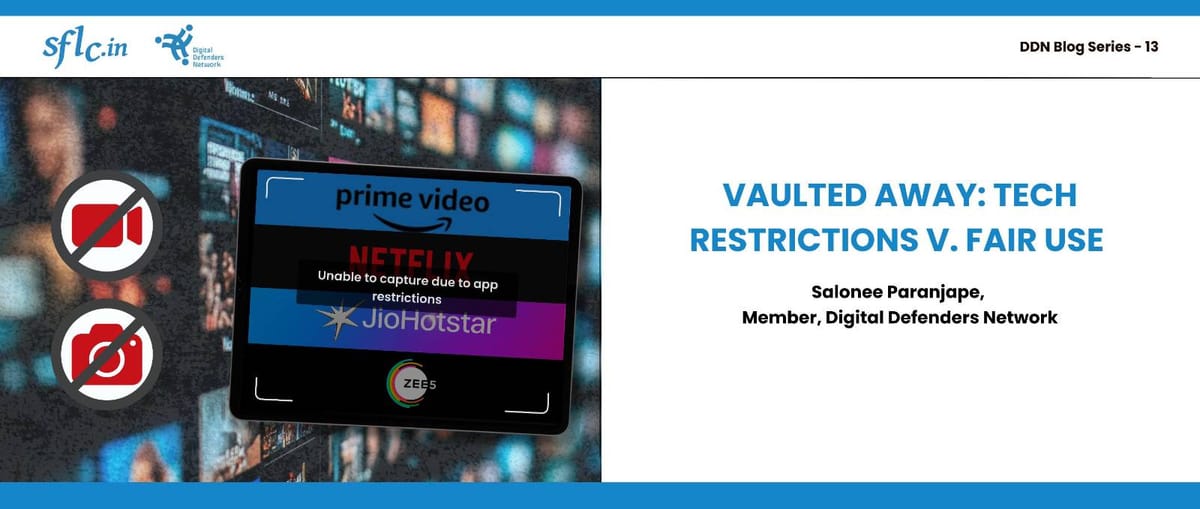
Recently, while attempting to take a screenshot of the credits list in a documentary, I realised that the OTT platform no longer allowed screenshots. This decision of several OTT platforms in India to ban screenshots underscores the tussle between digital copyrights and the technology designed to protect these copyrights. Azdhan. (2025, May 30) OTT Platforms Block Screenshots: What It Means for Fair Use and Content Creators in India?
This piece attempts to underline how the implementation of technology enabled IP restrictions negatively impacts fair use rights. Part I and II explore the nature, scope and rationale behind fair use rights and technology enabled IP restrictions and Part III discusses the interplay between the two. Finally, Part IV outlines the possible solutions and details a way forward.
- Fair Use Rights
The concept of owning a copyright in a work stems from Article 19(g) and Article 300A which deal with the Fundamental Right to practice any profession, trade, etc. albeit with certain reasonable restrictions and the constitutional right to property which includes incorporeal property such as copyright respectively.
In India, the primary law governing copyrights is the Copyright Act, 1957, “the Act”. Section 52 of the Act deals with fair dealings. The concept of fair dealings is a narrower concept based on statutory specifications while fair use is a wider concept based on the four factor test of fairness as detailed by the courts in the United States of America.
Section 52 details the various scenarios in which use of works with a subsisting copyright would not amount to infringement. The section details how a fair dealing with a literary, dramatic, musical or artistic work for the purpose of, inter alia, research, criticism, review or reporting current events in newspapers would not amount to infringement of copyright. The concept of fair use is grounded in the principle of information being a public commodity. Thus it is closely linked to the Fundamental Right to Expression (Article 19(1)(a) and the Fundamental Duty of every citizen to develop a spirit of inquiry (Article 51A (h)).
The United Kingdom also approaches this concept on similar terms. Chapter III of the Copyright, Designs and Patents Act, 1988 outlines the scenarios in which use of copyrighted works is permitted. These are similar to the Indian law and include provisions concerning personal copies for private use, research, news reporting, parody, etc.
Unlike India and the United Kingdom, fair use rights are approached with a slightly broader lens in the United States. Sec 107 of the Copyright Act, 1976 lays down a four factor test to determine the scope and extent of fair use rights. These factors are; the purpose of the use, nature of the copyrighted work, amount of the material used and the effect of use on the potential market for or value of the work.
While the approach may be different, most jurisdictions carve out fair use/ fair dealings as an exception to copyright. This ensures that a balance is created between a private right (copyright) and public interest.
- Technology Enabled IP Restrictions
Where there is a copyright, there are bound to exist mechanisms which protect such copyrights from infringement. In the digital world, these exist in the form of technology enabled IP restrictions. These can be understood as the various mechanisms deployed to prevent unauthorized access of copyrighted material.
These include, Digital Rights Management (DRM) systems, algorithmic filters, proprietary distribution channels and other anti-circumvention techniques. Scharf, N. (2010) Digital Rights Management and Fair Use. European Journal of Law and Technology, 1(2). These mechanisms find their roots in the WIPO Copyright Treaty 1996, and the WIPO Performances and Phonograms Treaty 1996.
India has also amended its Act to align with the said treaties. These amendments include; Section 65A which protects technological measures which are applied in order to protect the rights granted under the Act and Section 65B which, inter alia, makes the act of tampering with any rights management information a punishable offence.
In this digital age, as conversations and content consumption moves online, these restrictions become even more significant, since those who control access to copyrighted works also control how the users interact with such works.
- The Conundrum
Unlike how straightforward these techniques sound on paper, the devil lies in the implementation. The same techniques deployed to prevent infringement, sometimes overreach their mandate and are applied in a manner which prevents fair use of the copyright. This happens when blanket restrictions are imposed with respect to copyrighted material and as a consequence, fair use, which although permissible under law, is also restricted.
This creates a situation where works one is legally permitted to use (for research, satire, or even reciting a published work in public) become inaccessible due to technological barriers imposed by companies and platforms.
This stems in the form of YouTube preventing one from playing snippets of a movie in a review video to Google Books preventing one from downloading certain books even when they are to be used for personal research.
This is in sharp contrast to the current law of the land which does not envisage such blanket restrictions. Section 65A (1) does not penalise the creation of circumvention mechanisms. It only punishes those circumventing acts which are done with the intention of infringing the rights protected by such measures. The consideration for intent as a vital ingredient is completely missing when the aforesaid restrictions are applied. Moreover, Section 65B also only makes those acts punishable which are done knowingly and without authority. These considerations are also absent when one is restricted from accessing works; an act which is permissible under the law but is made impermissible by networks and platforms.
The law creates a monopoly by granting ownership of copyright, however, in case of such restrictions, the monopoly actually rests in the hands of the companies controlling these networks and platforms. Therefore, it is the companies which own these networks, software and platforms which end up acting as gatekeepers to legally accessible information.
- Possible Solutions and a Way Forward
The Act does not specifically deal with the aforesaid scenarios. Therefore, in order to find legal remedies, one has to turn to common law and civil law remedies and methods adopted by other jurisdictions.
An effective way of breaking this monopoly over works is to shift the responsibility from individuals being required to take steps to exercise their rights. We may look at Article 5 and 6(4) of the 2001 European Copyright Directive which provides for measures to be taken by the member states to make the benefit of exceptions such as fair use available to beneficiaries. Therefore, the law by design prioritises the exercise of fair use rights.
Injunctions
If one is prevented from accessing content for the purposes specified in the Act, one may file an injunction suit in order to be permitted access to such content and restrict content providers from deploying such techniques and methods.
However, the effectiveness of this remedy remains to be seen. One may also pray for a dynamic injunction, similar to those awarded by courts in cases of online piracy. To keep pace with the dynamic nature of infringement, courts have granted injunctions which automatically extend to mirror or alphanumeric variations of the originally injuncted website. This ensures that the applicant does not have to repeatedly approach the court for a separate order for each new URL/ IP address. (UTV Software Communication Ltd. v. 1337X.To, 2019 SCC OnLine Del 8002).
Unjust enrichment
The concept of unjust enrichment is based on the common law principle that one must not be benefited at the expense of another. In India, this principle is primarily codified in sections 68 to 72 of the Indian Contract Act, 1872 which deal with certain quasi-contracts. The case in hand may not fall under these specific provisions but one may file a suit for unjust enrichment as a common law remedy.
The effectiveness of this remedy will depend, inter alia, on the evidence needed to establish the benefits being enjoyed by these companies at the cost of restricting exercise of fair use rights.
Regulatory Remedies
Instead of focusing solely on legal remedies, I propose we should also focus on regulatory compliance requirements. These requirements could be;
- The requirement of a declaration from an individual as to the scope and purpose of use when accessing works on these networks, platforms, etc. A database of such declarations could be maintained which can be looked into, in case of infringement allegations.
- Instead of platforms placing a blanket restriction on downloading, there can be an inbuilt timer which limits the duration of downloads of audio and video content and further restricts the number of downloads permissible with respect to a certain work.
Therefore these restrictions effectively curtail how an individual engages with content and thus infringe upon the fundamental right to access information. Furthermore, these restrictions in essence, imply that any interaction with a copyrighted work is with the intent of infringement. However guilt cannot be presupposed and it is this principle that we must seek to safeguard.